The process that happens behind a website, when you click a button, filling out a form or scrolling through a feed, is a combined work of frontend and backend development. One shape the experience and the other powers the engine.
When people search for the difference between frontend and backend, they’re usually trying to answer a practical question.
- Which role should I learn?
- What does a frontend developer vs backend developer actually do day to day?
- Or how does full stack development fit into all of this?
This article breaks down how client-side and server-side technologies work together to build modern web applications.
Frontend vs Backend Development: Core Differences Explained
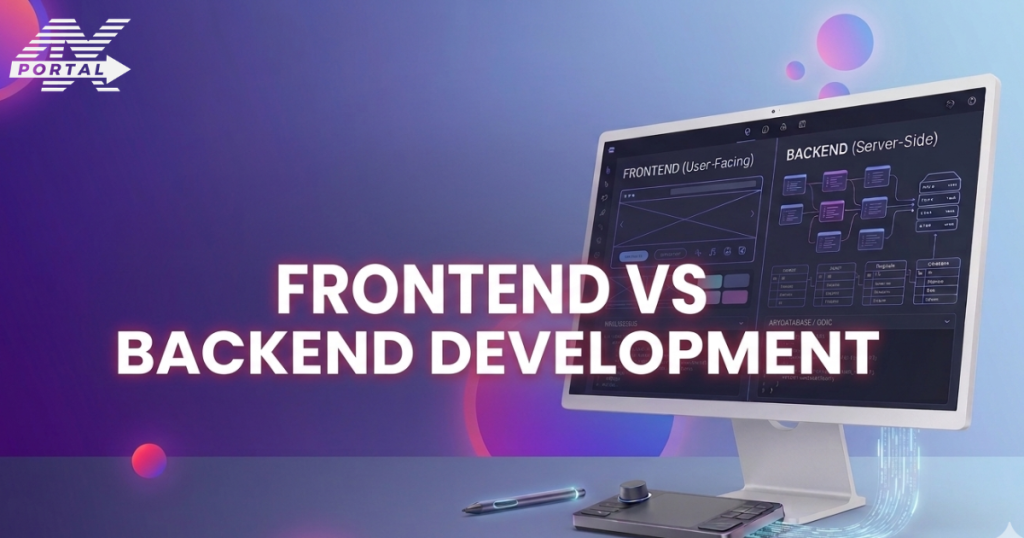
Frontend is what users see and interact with in their browser, while backend is what runs on the server and makes everything function properly behind the scenes.
Quick Snapshot
| Frontend | Backend |
| Visual Interface | Server-side Logic |
| Runs in Browser | Runs on Server |
| Focusses on UX/UI | Focusses on data & System |
| Uses HTML, CSS, JavaScript | Use languages like Python, Java, PHP |
In Simple Terms
- Frontend is the layout, buttons, animations, navigation menus, and overall user interface. It’s built with HTML for structure, CSS for styling, and JavaScript for interactivity. It focuses on user experience, responsiveness, and accessibility.
- Backend is the server-side logic that handles databases, authentication, APIs, and application performance. It uses programming languages like Python, Java, and PHP to process requests, manage data, and ensure security.
In short, the difference between frontend and backend comes down to visibility and responsibility. Frontend deals with presentation and interaction. Backend manages data flow, system architecture, and business logic. Together, they create a complete web application that looks good and works reliably.
What Is Frontend Development?
Frontend development is the part of web development that focuses on what users actually see and interact with on a website or web application. It covers the user interface (UI) and user experience (UX), making sure everything looks clean, loads properly, and feels smooth to use.
Core Technologies Used
Frontend developers rely on a few essential technologies:
- HTML: Constructs a webpage’s structure
- CSS: Handles styling, layout, colors, and responsiveness
- JavaScript: Adds interactivity and dynamic behavior
These tools work together to turn static designs into responsive, interactive experiences.
Key Responsibilities
A frontend developer typically focuses on:
- Designing and implementing page layouts.
- Optimizing responsiveness for mobile, tablet, and desktop.
- Ensuring cross-browser compatibility.
- Improving accessibility for all users.
- Enhancing performance and page load speed.
The goal is simple: make the interface intuitive and friction-free.
Who Is a Frontend Developer?
The part of a product that users can touch and feel is created by a frontend developer. They translate design mockups into working interfaces, fine-tune visual details, and ensure smooth interaction. It is a role that blends creativity with logic.
What Is Backend Development?
Backend development is the web development part that runs behind the scenes. It handles server-side logic, manages databases, control authentication, and ensures overall application performance.
Core Technologies Used
Backend systems are typically built using programming languages and database technologies such as:
- Python
- Java
- PHP
- Node.js
- Databases like MySQL and MongoDB
These tools allow developers to write server logic, manage APIs, connect applications to databases, and handle data exchange between client and server.
Key Responsibilities
Backend development focuses on:
- Handling data storage and database management.
- Managing APIs for communication between systems.
- Securing applications through authentication and authorization.
- Processing business logic that defines how the application behaves.
Who Is a Backend Developer?
A backend developer builds and maintains the systems that store, retrieve, and process information securely. They design server architecture, optimize database queries, and ensure scalability and security.
Full Stack Development Explained
Full stack development is the ability to handle both the client side and the server side of a web application. Instead of specializing only one system, a full stack developer understands how everything connects, from browser rendering to database queries In practical terms, a full stack developer can:
- Create user interfaces with JavaScript, HTML, and CSS.
- Write server-side code that handles logic, authentication, and APIs.
- Manage databases like MySQL or MongoDB for data storage and retrieval.
- Deploy applications to live servers or cloud platforms.
They see the entire web development lifecycle, not just one slice of it. That means they understand:
- How a button click in the browser triggers a server request?
- How that request interacts with the database?
- How the response flows back to the user interface?
If frontend is the face of an application and backend is the brain, full stack connects both.
How Do Frontend and Backend Work Together?
When you click a button on a website or app, that’s your frontend in action—what you see and interact with. Behind the scenes, a request zips over to the server, where the backend kicks in to process it. The server talks to the database, fetches the information you need, and sends it back. Finally, the frontend displays the result seamlessly on your screen.
It’s teamwork in perfect sync—without one side, the whole experience would fall apart. This collaboration ensures websites and apps feel smooth, responsive, and reliable, giving users the experience they expect.
Contact 4x Portal to bring frontend and backend together effortlessly.